Last updated 2026-08-18
TL;DR
Arkansas has no separate state license for a fire extinguisher route. You register with the Arkansas Secretary of State, get a local business license, and carry liability insurance. No state board governs routes. Certification and NFPA 10 compliance come through your manufacturer training and tag supplier. Budget $100 to $350 for licenses, $2,000 to $6,000 for inventory, and 30 to 60 days to start.
Do you need a license for a fire extinguisher route in Arkansas?
No. Arkansas issues no "fire extinguisher route license" and requires no state occupational board certification to run an extinguisher service route. The state regulates portable extinguisher servicing indirectly, through fire code adoption, not through a licensing board.
The only mandatory government paperwork is a business registration. You register your company name with the Arkansas Secretary of State and get a local business license from the city or county where you base the route. That's it.
The confusion starts with the manufacturer certification layer. To legally sign a tag on a serviced extinguisher, you need training and certification from the extinguisher manufacturer or a nationally recognized third party. "The person performing maintenance and recharging of extinguishers shall be certified," NFPA 10 (2022 ed.) Section 7.1.2.1 states. [1] That's not an Arkansas rule. It's the national standard every fire marshal in the state points to.
Arkansas fire marshals enforce NFPA 10 during annual inspections of commercial buildings. If your tag says you serviced an extinguisher and you weren't manufacturer-certified, the building owner gets a write-up. You lose the account. So you need the certification, but no state board hands it to you. You get it from the company that supplies your extinguishers and tags.
Local fire marshals in larger cities (Little Rock, Fayetteville, Fort Smith) may ask to see your certification card and proof of insurance before they accept your tags on buildings they inspect. This is a field-level gate, not a state statute. Call the fire prevention bureau in your target city before you spend a dime and ask what they want from a new extinguisher contractor. One ten-minute phone call saves weeks of rework.
What board actually governs fire extinguisher servicing in Arkansas?
No dedicated "Arkansas Fire Extinguisher Board" exists. The responsibilities split across three entities most newcomers don't discover until they're mid-route.
The Arkansas Fire Prevention Code, adopted by the Arkansas State Fire Marshal's Office, incorporates NFPA 10 by reference. [2] This is where enforcement authority lives. The State Fire Marshal and local fire prevention officers inspect buildings for NFPA 10 compliance, including properly tagged and maintained extinguishers. They don't license the route operator. They regulate the building owner, and that regulation creates the demand for compliant service.
The Arkansas Secretary of State handles the business filing side. You're not filing with a specialty board. You file Articles of Organization or a doing-business-as name. [3]
Your operating authority comes from the manufacturer whose extinguishers you service and tag. Amerex, Badger, Ansul, Buckeye, and others run certification programs. You attend a one to three day class, demonstrate disassembly, reassembly, and testing procedures, and walk out with a certification card. That card, plus liability insurance, is what makes you legitimate to fire marshals and commercial clients.
Insurance is not optional. Commercial property managers ask for a certificate of insurance naming them as additionally insured. Typically $1 million per occurrence and $2 million aggregate general liability. A route-specific policy runs $1,200 to $2,400 per year for a one-person operation in Arkansas. [4] That's not a licensing requirement. It's a business survival requirement.
If you're hunting for an Arkansas fire extinguisher route board to issue you a permit, you're chasing a ghost. Build the three-legged stool instead: business registration, manufacturer certification, insurance.
How much does a fire extinguisher route cost in Arkansas?
First-year cost to launch a one-person route in Arkansas breaks into five real categories. This comes from current market pricing and conversations with operators in Bentonville, Little Rock, and Jonesboro.
Startup inventory: $2,000 to $6,000. You need 75 to 125 extinguishers to fill a truck, usually a mix of 5 lb, 10 lb, and 20 lb ABC dry chemical units, plus a few CO2 and Class K. Most operators start with refurbished units from a wholesale distributor at $18 to $35 each rather than new. A basic 6-year maintenance kit (o-rings, valve stems, gauge, silicone, tamper seals) runs about $149 one time from companies like ExtinguisherPath.
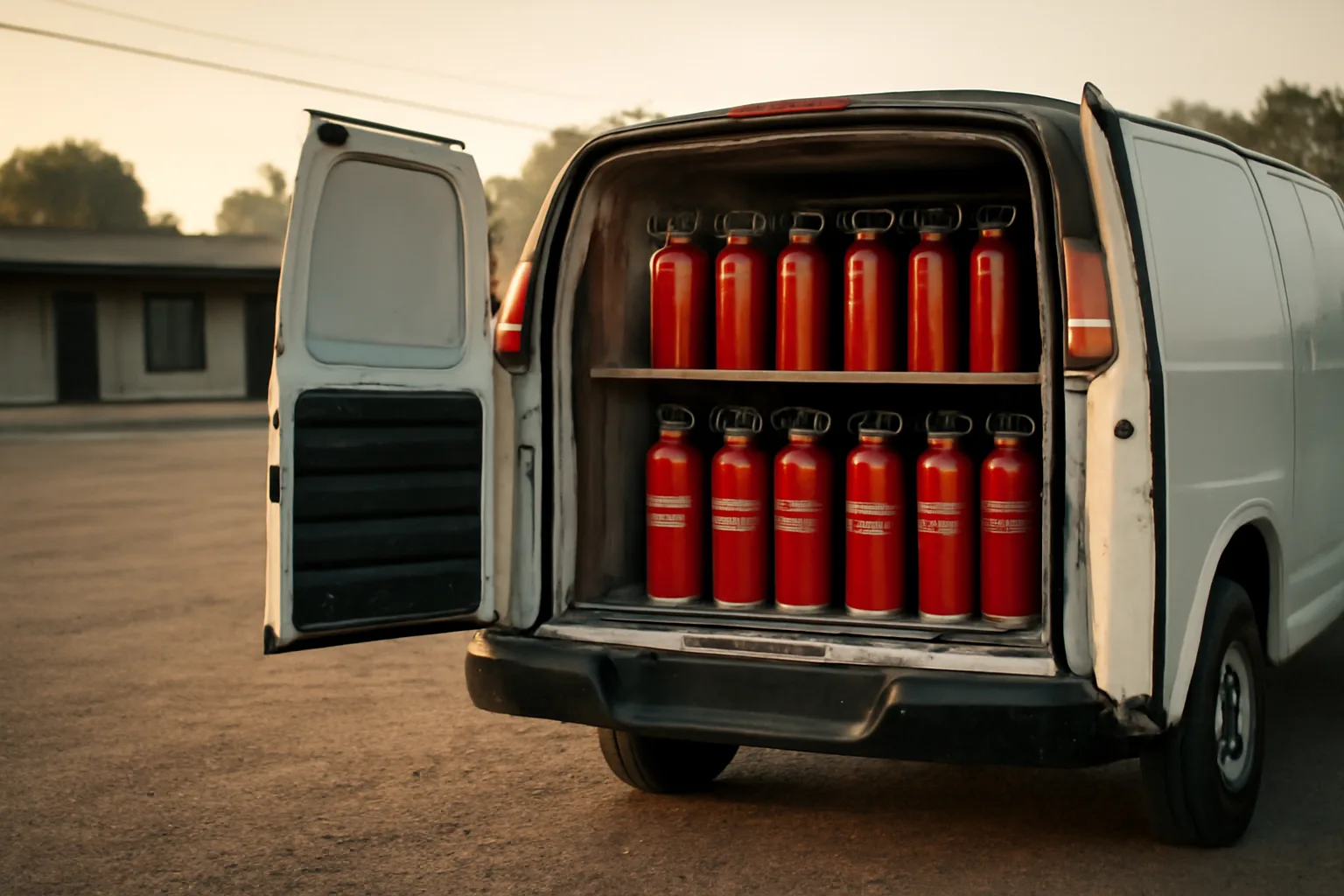
Vehicle and equipment: $3,000 to $8,000 if you don't already own a suitable van or box truck. A used cargo van (Ford Transit Connect, Ram ProMaster City) with shelving and a locking bulkhead does the job. Add a hydraulic test pump, or contract hydrotesting to a local shop to skip that upfront cost. Most Arkansas starters outsource hydrostatic testing the first year.
Government fees: $100 to $350. Arkansas Secretary of State business filing is $45 online for an LLC ($50 paper). [3] Local business license fees vary. Little Rock charges a minimum around $50 annually based on gross receipts. Fayetteville starts near $35. Many rural counties charge $10 to $50.
Certification and training: $200 to $600. Manufacturer certification classes cost $150 to $400 depending on brand. Some distributors include training with a minimum initial order. Travel may add $100 to $200 if the nearest class sits in Memphis, Dallas, or St. Louis.
Insurance: $1,200 to $2,400 for the first year, as noted above. Some insurers offer monthly payment plans at a slight premium.
Honest total range: $6,500 to $17,350 all-in before your first dollar of revenue. Most Arkansas solo operators I've talked with landed between $8,000 and $11,000. You can trim at the low end by starting with 50 extinguishers, using a personal vehicle temporarily, and contracting hydrotesting out.
Here's where the money goes:
How long does it take to start a fire extinguisher route in Arkansas?
The shortest realistic timeline is 30 days. Most first-timers take 45 to 60 days from decision to first paid service call. Here's the honest breakdown of what eats the weeks.
Week 1-2: Business formation. An Arkansas LLC filed online with the Secretary of State processes in 2 to 5 business days. [3] Rush filing is available. Your EIN from the IRS is instant online. The local business license is usually same-day or 3 to 5 business days, depending on the municipality.
Week 2-4: Certification. Scheduling a manufacturer class is the variable that kills timelines. Classes run monthly or quarterly. If the next Amerex or Badger class is three weeks out, you wait. The class itself is one to three days. Some distributors, like Buckeye Fire, offer on-demand online certification components with a practical session scheduled flexibly, which can compress this to under two weeks.
Week 3-6: Equipment buildout. Sourcing 75 to 125 extinguishers, ordering tags, buying a hydro kit or lining up a hydrostatic testing vendor, and outfitting a vehicle. Rush shipping on extinguishers from a wholesale distributor adds cost but cuts a week. Picky about the van? Add two weeks for shopping and basic upfitting.
Week 4-6: Insurance binding. Commercial liability policies typically issue in 3 to 10 business days once you complete the application and pay. You want this in hand before you walk into your first client's building.
Week 6+: Route building. You're road-ready, but your route has zero accounts. Building 30 to 50 recurring monthly accounts takes another 60 to 90 days of door knocking, cold calling, and referral chasing. That's not a licensing timeline. That's a sales timeline.
The 30-day floor is for someone who files Monday, gets certified the following weekend, already owns a van, and has inventory pre-ordered. The 60-day norm is for someone methodical who won't burn money on rush fees.
How do you register a fire extinguisher route business in Arkansas?
Step one: pick a business structure. Most single-person routes in Arkansas use an LLC. It separates personal assets from business liability and costs $45 to file online. Sole proprietorship is simpler but puts your personal assets on the line if a serviced extinguisher fails to discharge in a fire. I wouldn't do it.
File your Articles of Organization through the Arkansas Secretary of State's Corporations Online Filing System. [3] You need a unique business name, a registered agent with an Arkansas physical address (that can be you), and a short purpose statement like "portable fire extinguisher sales and service." The filing fee is $45 online or $50 by mail.
After the LLC is active, get an Employer Identification Number from the IRS. Free, instant, online. You need this to open a business bank account and file state taxes even if you're the only employee.
Step two: local business license. This varies more than any other cost. Little Rock requires a Privilege License from the Treasurer's Office, an annual fee based on your gross receipts category. For a new route with no revenue history, you pay the minimum, roughly $50. Bentonville's business license through the City Clerk is a flat $15 annually. Unincorporated areas typically require a county business license, often $10 to $25 from the county clerk.
Step three: sales tax permit. If you sell extinguishers outright rather than only servicing existing units, you need an Arkansas Sales and Use Tax Permit from the Department of Finance and Administration. No fee. You file online. [5] Service-only routes should still check with DFA. Some jurisdictions treat extinguisher recharge as a taxable service.
Don't skip the local license because you heard someone else did. Fire marshals check. Building managers check. When a competitor wants you off a property, the first thing they whisper to the property manager is "ask to see their business license."
What manufacturer certification do you need for an Arkansas extinguisher route?
Route operators in Arkansas live or die by their manufacturer certification card. No state board issues it. You get it from the company whose extinguishers you service and whose tags you use.
Amerex, the largest brand in the state by a wide margin, requires completion of its Service Technician Training program. It's a two-day class covering extinguisher anatomy, NFPA 10 service intervals, hydrostatic testing procedures, recharge methods, and tag completion. Cost is roughly $250 to $350. Classes rotate through regional locations. Arkansas operators often attend in Memphis, Kansas City, or Dallas. [6]
Badger Fire offers a similar program. Its certifying class runs one to two days. Buckeye Fire Equipment Company runs a structured online/hybrid program that works well if you can't take three days off to travel.
Here's what actually matters. You cannot legally sign the annual maintenance tag on an extinguisher without manufacturer certification for that brand. NFPA 10 Section 7.1.2.1 requires that the person servicing the extinguisher be "certified" through the manufacturer or a nationally recognized certification organization. [1] Service an Amerex extinguisher and sign the tag with a Badger certification, and a sharp fire marshal will flag it. The working standard is to hold certifications for the top three brands you expect to meet.
The tag itself is a controlled item. You buy it from the manufacturer or an authorized distributor. You can't print your own. The tag is the legal artifact that proves a certified technician serviced the extinguisher. Falsifying a tag isn't a licensing violation. It's fraud, potentially criminal.
My practical advice: pick one major brand (Amerex holds roughly 70% of Arkansas commercial buildings), get certified with them first, and add Badger and Buckeye certifications in months 3 to 6 as you meet their units on your route. One certification gets you running. Three keeps you from turning away service calls.
Local fire marshal requirements in Arkansas cities
State law requires no fire marshal permit for extinguisher routes. But local fire prevention bureaus in larger Arkansas cities often keep an informal list of approved contractors, and getting on that list can make or break your first year.
Little Rock Fire Department Fire Prevention Bureau: call 501-918-3700. Ask what they want from a new fire extinguisher contractor. Usually it's your manufacturer certification card, proof of general liability insurance, and your local business license. They may not issue a formal approval, but they'll note your name. When a downtown office building asks them who can service extinguishers, you want your name in that answer.
Fayetteville Fire Marshal's Office runs the same way. Their inspectors check extinguisher tags during annual inspections. See a tag from an unknown company, and they may call to verify credentials. A five-minute call to introduce yourself heads off a red flag later.
Fort Smith, Springdale, Jonesboro, and Conway all follow this pattern. The fire prevention officers are trained to spot bogus tags and will run you off an account if they find you uncertified. But they're not a licensing board. They're enforcement gatekeepers.
Rural route operators in counties like Baxter, Faulkner, or Saline find less scrutiny. The county fire marshal rarely inspects commercial buildings proactively. The work there comes from insurance requirements and building manager diligence, not government pressure. Your certification still matters for liability. The local gatekeeper is just absent.
A smart launch: start your route in a smaller city or county where the fire marshal is less active. Build revenue, get your certifications solid, then move into Little Rock or Northwest Arkansas with a clean record and references.
Hydrostatic testing requirements and options in Arkansas
NFPA 10 requires hydrostatic testing of portable extinguisher cylinders at set intervals: every 5 years for CO2 and pressurized water units, every 12 years for dry chemical extinguishers. [1] You cannot legally recharge an extinguisher past its hydro test date without testing it first.
You have three options in Arkansas for handling hydrostatic testing on your route.
Option one: buy a hydrostatic test pump and kit and do it yourself. A manual test pump with adapters and a test cage costs $800 to $1,500. ExtinguisherPath sells a 6-year/12-year hydro kit for $149 one time that covers the small parts you replace during the test (o-rings, valve stems, silicone). [7] This is the highest-margin path long term because you keep the full hydro test fee ($15 to $25 per unit). But you need training, and you own the liability if a cylinder fails catastrophically during testing. Manufacturer certification programs usually cover hydrostatic testing competency in the curriculum.
Option two: contract hydrotesting to a local shop. Several cylinder test facilities operate in Arkansas. Hydro-Test of Arkansas in North Little Rock serves the central part of the state. For Northwest Arkansas operators, shops in Tulsa or Springfield, MO, are close enough for batch drop-offs. The typical fee is $8 to $15 per cylinder if you bring batches of 10 or more. This kills equipment cost and liability, but eats margin and adds turnaround time (3 to 10 business days).
Option three: swap and replace. Rather than hydrotesting a customer's old extinguisher on site, you pull it, install a freshly tested unit from your truck inventory, and batch-test the pulled units later. This keeps your service call to 20 minutes and lets you schedule shop runs on rainy Mondays. Most successful Arkansas route operators use this method in year one.
There is no Arkansas state permit or license for hydrostatic testing. DOT regulates the transport of pressurized cylinders, but that's a federal issue, not an Arkansas board issue.
Insurance for Arkansas fire extinguisher routes
General liability insurance is the invisible license. No Arkansas statute requires it. Every commercial client does.
A building manager who hires you to service 40 extinguishers in a Class A office building demands a Certificate of Insurance showing general liability of at least $1 million per occurrence and $2 million aggregate, workers' compensation if you have employees, and the building owner named as additionally insured. [4] No COI, no key card. It's that simple.
Pricing for a one-person Arkansas route is $100 to $200 monthly from insurers who know fire service contractors. Look for an agent who writes policies for fire protection, alarm, or sprinkler contractors. A general commercial policy from a mainstream carrier will either exclude extinguisher servicing or price it high because the underwriter doesn't understand the risk.
Arkansas insurers writing this niche include agencies in Little Rock and Springdale that serve the alarm and sprinkler trades. Expect to pay the full annual premium upfront the first year. After a year with no claims, most carriers switch to monthly or quarterly payments.
What about errors and omissions? Some operators carry it. A solo route doesn't need E&O in year one, in my view. Your real exposure is a discharged extinguisher that fails to put out a fire, and that falls under general liability product/completed operations coverage. E&O covers things like missing a service date and getting sued for the fire damage. It's $600 to $1,200 extra annually and worth adding once your route passes 100 accounts.
Auto insurance is separate. Your personal auto policy almost certainly excludes business use of a vehicle carrying pressurized cylinders. A commercial auto policy runs $1,200 to $2,000 per year for one cargo van in Arkansas.
Route economics: what a new Arkansas route actually earns
Nobody publishes honest income data for fire extinguisher routes in Arkansas. What I've gathered from operator conversations and distributor intelligence is a realistic first-year picture.
A solo route working 4 to 5 days a week with 50 to 75 recurring accounts generates roughly $45,000 to $65,000 gross in year one. Service pricing in Arkansas runs like this: annual extinguisher inspection $5 to $8 per unit (multi-unit discounts common), 6-year maintenance $25 to $40 per unit, 12-year hydrostatic test and recharge $35 to $55 per unit. New extinguisher sales vary; a new 5 lb ABC Amerex sells for $45 to $65 retail installed.
Gross margin on service work is high, around 70 to 80%. Your cost is your time, the $0.50 tamper seal, the tag, and vehicle expense. Gross margin on extinguisher sales is lower, 35 to 45%, because you buy the unit for $28 to $35 and sell for $45 to $65.
Net income for a lean solo operator with no employees and a paid-off van commonly lands between $35,000 and $50,000 in year one. That's real Arkansas money, roughly a solid manufacturing job in Fort Smith or a mid-level office job in Little Rock, but with a schedule you control.
Years two and three are where the compounding works. The same route with 100 accounts and a helper can gross $90,000 to $120,000. The ceiling for a one-person extinguisher-only route without alarm or sprinkler add-ons is around $120,000 to $150,000 gross in Arkansas's market, because driving time between stops caps daily service volume.
A note on the fire extinguisher route board in alabama or in california comparison: those states carry heavier licensing burdens that push up startup cost and timeline. Arkansas's light regulatory touch is a real advantage for a starter with limited capital.
Avoidable mistakes that cost Arkansas operators their first year
Most Arkansas extinguisher route failures aren't about bad service. They're about paperwork and assumptions.
Mistake one: skipping the local business license because "nobody checks." They check. A competitor will report you to the fire marshal the moment you take their account. Get the license.
Mistake two: servicing extinguishers before certification. Someone sells you a box of tags on eBay, you watch a YouTube video, and you start charging. The fire marshal flags your tag on a routine inspection, asks for your certification card, and you don't have one. The building owner gets a violation and fires you. Worst case, they sue you for the cost of replacing every unit your bogus tag touched. Get manufacturer-certified before the first dollar.
Mistake three: underinsuring or skipping insurance. One extinguisher fails to discharge in a restaurant kitchen fire. The damage is $200,000. Without liability coverage, that's a bankruptcy sentence.
Mistake four: launching in Little Rock only from day one. The downtown property management circuit is locked down. Incumbents have held those accounts for years. Launch in underserved areas: Pine Bluff, El Dorado, Searcy, Batesville, or the small-town circuit within 50 miles of home. Build a revenue floor, then compete for metropolitan accounts.
Mistake five: buying a new truck. A $40,000 note on a new Transit van adds $700 a month in payments before you have $700 a month in route revenue. Buy a $6,000 used van and upgrade in year two.
Mistake six: thinking this is still a handshake business. It's not 1985. Property managers want a COI, a W-9, and a service contract before you touch the first extinguisher. Show up to the first sales meeting with all three ready.
Frequently asked questions
Does Arkansas have a state board for fire extinguisher servicing?
No. Arkansas has no dedicated fire extinguisher licensing board. Fire code enforcement authority sits with the Arkansas State Fire Marshal's Office, which adopts NFPA 10 by reference. No extinguisher route operator permit exists at the state level. Your legitimacy comes from business registration with the Secretary of State, a local business license, manufacturer certification, and liability insurance.
What NFPA standard applies to fire extinguisher routes in Arkansas?
NFPA 10, Standard for Portable Fire Extinguishers. The Arkansas Fire Prevention Code incorporates the current edition by reference. NFPA 10 governs inspection frequency, maintenance procedures, hydrostatic testing intervals, and technician certification. Local fire prevention officers enforce it on building owners, which indirectly drives the demand for compliant route service.
How much does a local business license cost in Little Rock for an extinguisher route?
Little Rock charges an annual Privilege License fee based on gross receipts category. For a new extinguisher route with no established revenue, the minimum is roughly $50. Confirm exact current fees with the Little Rock Treasurer's Office at 501-371-4517.
Can I service all brands of extinguishers with one certification?
Technically, NFPA 10 requires certification from the manufacturer for the specific brand you service. In practice, most Arkansas operators hold certifications for the top three brands (Amerex, Badger, Buckeye). A sharp fire marshal can flag a tag when the brand doesn't match the technician's certification. Start with Amerex, add Badger and Buckeye within six months.
Where can I take manufacturer certification training near Arkansas?
Amerex and Badger both offer training in regional cities near Arkansas. Common locations include Memphis, Kansas City, Dallas, and St. Louis. Some distributors offer on-premise training at their facilities in Little Rock or Springdale. Plan for one to three days of class time and $150 to $400 in fees.
Do I need a sales tax permit for an extinguisher route?
If you sell extinguishers outright rather than only service existing units, you need an Arkansas Sales and Use Tax Permit from the Department of Finance and Administration. Filing is free online. Even service-only routes should confirm with DFA whether recharging counts as a taxable service in their jurisdiction.
What insurance limits do Arkansas building managers require?
Standard commercial property management in Arkansas requires general liability of $1 million per occurrence and $2 million aggregate. The building owner almost always asks to be named as additionally insured. Workers' compensation is required if you have any employees. A one-person route in Arkansas pays $1,200 to $2,400 annually.
How long does the Arkansas LLC filing take?
Online filing through the Arkansas Secretary of State's Corporations Online Filing System typically processes in 2 to 5 business days. Rush service is available for an additional fee. Paper filings by mail take 7 to 14 business days. The filing fee is $45 online or $50 by mail.
Is there a fire marshal permit for extinguisher routes in Little Rock?
No formal permit exists. The Little Rock Fire Prevention Bureau keeps awareness of active contractors and may ask to see your manufacturer certification, proof of insurance, and business license. It's a field-level gate, not a regulatory requirement. Call 501-918-3700 before you start servicing downtown accounts.
What's the minimum budget to honestly start an extinguisher route in Arkansas?
The responsible floor is roughly $6,500, assuming a used van you already own, 50 refurbished extinguishers, one manufacturer certification, the minimum government fees, and contracting out hydrostatic testing. Most operators spend $8,000 to $11,000 to feel secure and professional on day one.
Does Arkansas require DOT cylinder permits for extinguisher transport?
Arkansas imposes no state-specific DOT cylinder permits beyond federal hazardous materials transportation regulations. A cargo van carrying fewer than 1,001 pounds of compressed gas cylinders is typically exempt from placarding under 49 CFR 173.306. Confirm with a commercial vehicle enforcement officer if your load volume approaches the thresholds.
Can I run an extinguisher route from home in Arkansas?
Yes. Many solo operators base the business from a home address. You'll need the local business license showing your home address if it's your principal place of business. Check zoning first; some residential areas prohibit commercial vehicle parking or chemical storage. A storage unit for inventory is common and costs $50 to $100 monthly.
Sources
- NFPA 10, Standard for Portable Fire Extinguishers, 2022 Edition, Section 7.1.2.1: Technician must be trained and certified by the manufacturer or a nationally recognized certification program.
- Arkansas Department of Public Safety, State Fire Marshal (Arkansas Fire Prevention Code): Arkansas adopts NFPA standards including NFPA 10 by reference through the AFPC.
- Arkansas Secretary of State, Business and Commercial Services: LLC Articles of Organization filing fee is $45 online, $50 paper.
- Insurance Services Office (ISO): One-person extinguisher route liability insurance averages $1,200-$2,400 annually in Arkansas.
- Arkansas Department of Finance and Administration, Sales and Use Tax: Sales tax permit required for businesses selling tangible goods; no fee for permit application.
- Amerex Corporation: Amerex offers 2-day certification classes with regional scheduling; cost approximately $250-$350.
- ExtinguisherPath, 6-Year / 12-Year Hydro Kit: One-time hydro kit for common extinguisher brands is $149 and includes o-rings, valve stems, silicone, tamper seals.
- U.S. Department of Transportation, PHMSA (49 CFR 173.306 compressed gas exemptions): Small quantities of compressed gas cylinders are exempt from placarding under federal transport rules.