Last updated 2026-08-18
TL;DR
Arkansas requires a Fire Extinguisher Permit from the State Fire Marshal. You file an application, pay a fee ($50 or $200 by business class, plus a $5 permit tag per extinguisher), and pass a written exam on NFPA 10. There is no business license just for routes, but you need the permit before you tag any extinguisher in the state.
do you need a license for a fire extinguisher route in arkansas?
Yes. Arkansas law is specific. AR Code § 20-22-702 says any person who installs, services, hydrostatically tests, sells, or distributes portable fire extinguishers must hold a permit issued by the Director of the Arkansas Department of Public Safety through the State Fire Marshal. [1]
If you read the statute's exact language, it covers the work a route operator does every day: "No person, firm or corporation shall engage in the business of installing, servicing, hydrostatically testing, selling or distributing portable fire extinguishers unless such person holds a permit..." [1] This means one person with a valid permit can supervise a crew on a route, but each business entity must have the permit on file.
The permit is issued by the Fire Extinguisher Permitting Program housed in the Arkansas State Fire Marshal's Office. You cannot legally tag or recharge an extinguisher without the permit number on the tag. This isn't a county-by-county rule. It is statewide. Local fire marshals will check your tags during inspections at the businesses on your route. Operating without a permit can lead to fines or a cease-and-desist under § 20-22-706. [1]
A separate general business license (city or county) may still be required where you live or where you store inventory. Arkansas does not have a standalone "fire extinguisher route license." The permit is the only state license. If you hold an Arkansas T-Class license for fire extinguisher technician from the Fire Marshal's Office, that is a separate credential tied to specific testing privileges, not a blanket route permit. [2]
Contractor licensing through the Arkansas Contractors Licensing Board does not apply to fire extinguisher service work. A few people confuse it with fire sprinkler contractor licensing. Fire extinguisher work falls squarely under the Fire Marshal's Permitting Program.
what is the fire extinguisher permit in arkansas (and where do you get it)?
The only state-level license for a fire extinguisher route in Arkansas is the Fire Extinguisher Permit. Arkansas Code § 20-22-703 lays out three business categories: Class 1, Class 2, and Class 3. [1]
Class 1 covers businesses that service and sell extinguishers. Most route operators fall here. Class 2 is for hydrostatic testing firms. Class 3 is for distributors who do not service, just sell. The application must list the physical business address in Arkansas. The State Fire Marshal's office uses in-state addresses for compliance jurisdiction.
The permit is not available to out-of-state businesses unless they meet specific reciprocity or facility requirements confirmed directly with the Fire Marshal's Office. If you're out-of-state and want to do routes in Arkansas, you need that conversation before filing.
The permit application is available on the Arkansas Department of Public Safety website under Fire Extinguisher Permit Application Forms. As of the 2026 posting, the application asks for: business name and FEIN or Social Security Number, physical address, mailing address, business phone, type of business (Class 1, 2, or 3), name of permit holder, and fingerprint-based criminal background check consent from the permit holder. [1]
Arkansas additionally requires a "knowledgeable person" to pass a written examination on NFPA 10, the national standard for portable fire extinguishers. The exam is administered by the Fire Marshal's Office after your application is accepted. You do not have to take a practical test of recharging or disassembly for the permit, but you must know the code inside a classroom proctored setting. [1]
You'll find many shops that call themselves "Arkansas Fire Extinguisher Board." There is no board. The State Fire Marshal administers everything directly. That is important. When you hear "go to the board," it means the Fire Marshal's Office.
how much does a fire extinguisher route cost in arkansas?
Plan on a first-year cost between $1,500 and $3,200 if you do the permit right and buy minimal startup gear. The permit itself is the smallest line item. Here is how it breaks down, using publicly available Arkansas Department of Public Safety fee schedules and NFPA 10 equipment requirements. [1][3]
The Fire Extinguisher Permit application fee structure appears in Rule 053.00.20-004, published by the Fire Marshal's Office. Class 1 (service and sales) permits are currently $200 per year. Class 3 (distributor only) runs $50 per year. [1] There is also a $5 fee for each permit tag you purchase from the Fire Marshal's Office. Tags are serialized and essential. A route of 100 extinguishers means $500 in tags the first year. Many route operators start with 100 to 150 accounts, so budget that line carefully.
Training adds $200, $600. You either buy NFPA 10 ($65, $95 for the PDF from NFPA.org) and study on your own, or you pay an Arkansas-based instructor or community college for a 1- to 2-day prep course. Fire Protection Specialists in North Little Rock and a few independent consultants offer exam-prep classes. No state-mandated course is required by statute, but most first-time applicants need help with the NFPA 10 exam. [3]
Equipment is a bigger variable. A bare-minimum kit: used hydrostatic test pump ($300, $600), a calibrated scale ($150, $250), recharge agent (ABC dry chemical, roughly $2/lb in bulk), valve stems, o-rings, tamper seals, and a small nitrogen cylinder to start ($200, $400). If you send cylinders out for hydrostatic testing instead of running your own pump, you skip the pump but pay $12, $25 per cylinder tested at a Class 2 permit holder. Sending out is common for new routes. That keeps startup equipment under $1,000.
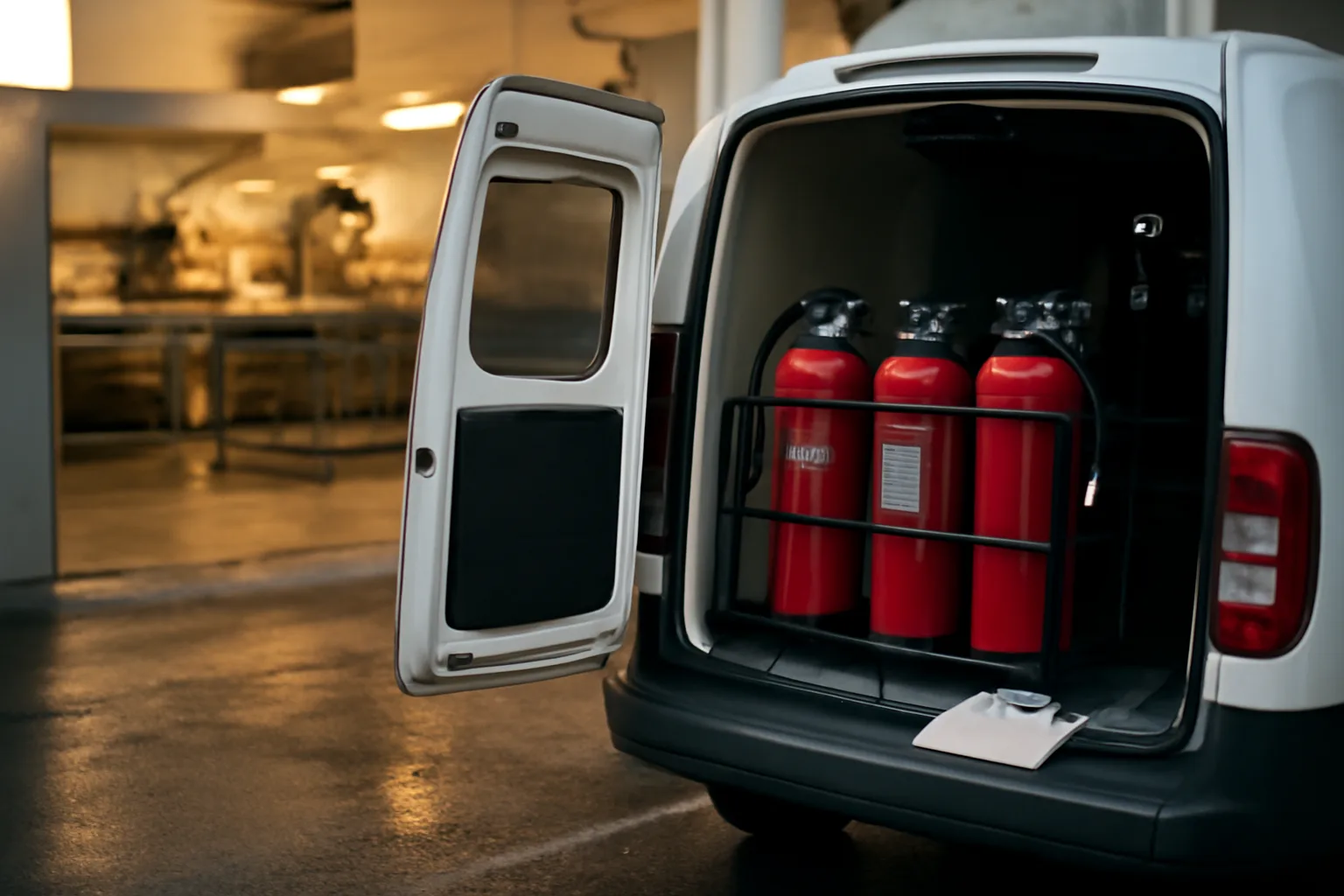
Vehicle costs vary widely. No Arkansas statute specifies a vehicle type. A cargo van or pickup with a weatherproof lock box meets NFPA 10's transport requirement and keeps agent dry. Insurance (general liability and inland marine for the equipment in transit) usually adds $600, $1,200/year in Arkansas for a new extinguisher service business. Umbrella quotes from local independent agents land in that range.
A practical first-year estimate: permit ($200), tags for 100 extinguishers ($500), NFPA 10 book and exam prep ($300), minimal recharge tools ($800), and insurance ($800). That totals $2,600. Add a few hundred for city/county business license if your locality requires one (check with your city clerk, costs range from $15 to $200).
ExtinguisherPath sells a $149 one-time 6-year or 12-year hydro kit that covers cylinder removal, valve rebuild parts, and reference guides for route operators. That kit has zero bearing on your Arkansas permit. It is gear, not licensing. Keep those lines separate in your head.
how long does it take to get a fire extinguisher route license in arkansas?
From the day you mail the application until the day a permit number appears on your tags, most new operators wait between 2 and 6 weeks. There are two variables: the background check turnaround and the exam schedule.
The Fire Marshal's Office reviews each application for completeness, then initiates a criminal history background check under § 20-22-703(d). [1] The statute exists to weed out convictions for crimes related to fraud, arson, or false statements under the Fire Prevention Code. No published average for Arkansas State Police or FBI channeler returns exists for this specific permit. Practitioners report 7 to 14 business days. If you have arrests in another state, add a week.
Once your background check clears, the Fire Marshal's Office contacts you to schedule the NFPA 10 written examination. The exam is offered at the State Fire Marshal's Office in Little Rock and sometimes at regional sites during training events. Exam dates are not daily. You might wait 1 to 3 weeks for the next slot. The office does not publish a fixed exam calendar online. You call after clearance.
After you pass the exam, the permit is issued typically within 5 business days. Then you order permit tags. Tag printing and shipping usually adds 3 to 5 business days. You are not legal to tag anything until you have the tags in hand with the permit number printed.
A realistic timeline from an operator in central Arkansas: application mailed June 2, background check cleared June 18, exam sat July 6, permit issued July 10, permit tags received July 16. That is just over 6 weeks. A friend in northwest Arkansas who walked the application into the Little Rock office and had an exam seat the same week finished in 18 days. The range is wide.
who needs to take the nfpa 10 exam?
Every Arkansas Fire Extinguisher Permit application must designate at least one "knowledgeable person" who sat for and passed the Fire Marshal's exam on NFPA 10. [1] Rule 053.00.20-004 uses that exact phrase. You cannot assign a figurehead. The person who passed must be the permit holder or an employee with documented authority over technical decisions.
If you are a solo route operator, that is you. If you are the owner with a crew of two, the owner can pass the exam and hold the permit, supervising the technicians. Arkansas does not require every tech on the truck to hold a permit. One permit covers the business. Technicians who recharge or tag extinguishers need to be trained internally and able to demonstrate competency if the Fire Marshal's office inspects, but no separate state license exists for a "fire extinguisher technician" in Arkansas beyond the T-Class license for hydrotesting. [2]
The exam itself covers NFPA 10 classification of fires, extinguisher ratings, inspection intervals (monthly, annual, 6-year, 12-year), hydrostatic test requirements, recharge procedures, and tag documentation. It is closed book. Scores to pass are not publicly posted, but practitioners report a 70% threshold. You want to know Chapter 7 (inspection, maintenance, and recharging) and Chapter 8 (hydrostatic testing) cold. The NFPA 10 digital handbook includes commentary that helps decipher test questions. [3]
fire extinguisher tags in arkansas: the real paper trail
Arkansas law mandates a durable tag fixed to every extinguisher after service. AR Code § 20-22-704 requires the tag to show the name, business address, and permit number of the permit holder, plus the date of service, type of service performed, and the signature of the person who performed it. [1]
Tags are not something you print yourself off a laser printer. You must purchase serialized permit tags directly from the State Fire Marshal's Office at the current $5 fee per tag. [1] The office controls tag numbers and reconciles them with your permit annually. The tag has your permit number preprinted. You fill in the service details and sign. Missing tags or tags reused across different extinguishers invite audit.
The tags are small: about 4 inches long by 1.5 inches tall, metallic or durable cardstock that resists oil and engine-room grime. You attach them with a wire tie or secure adhesive that prevents easy removal. NFPA 10 § 7.3.3 dictates attachment so that the tag cannot be inadvertently removed during normal handling. [3]
Recordkeeping matters. The Fire Marshal can audit your tags and records. AR Code § 20-22-705 requires each permit holder to maintain service records for at least 5 years. That means you keep a log (paper or PDF) of every extinguisher you touched: location, make, serial number, service date, and tag number. A clipboard habit plus a simple spreadsheet is enough for a solo route. [1]
One mistake that pops up during inspections: a tag that says "recharged" when only a visual inspection was done. The tag language must match the level of service actually performed (inspection, maintenance, recharge, hydrotest). The Fire Marshal's field staff can cite you for misrepresentation under § 20-22-706. Correct tagging is not optional.
city and county licenses you might need on top of the state permit
Arkansas does not require a separate fire extinguisher route license from any municipality, but local business privilege licenses or occupational licenses exist. These are tax registration and business permission slips, not competence permits.
If your business address is in Little Rock, the City of Little Rock Finance Department requires an annual business license ($25 for a home-based service business, potentially higher for a commercial bay). Fayetteville, Fort Smith, Jonesboro, and Conway all have similar ordinances. In unincorporated areas, no county-level business license is typically needed, but you should confirm with the county clerk.
Most importantly, a city business license does not authorize you to service extinguishers. It just says you are a business in the city. The Arkansas Fire Extinguisher Permit is the only document that authorizes the service work. You present the state permit to customers and to fire inspectors. You present the city license to the city tax collector, rarely otherwise.
So, the real paper stack for an Arkansas route: Fire Extinguisher Permit (Class 1) from the State Fire Marshal, plus a local business license if your city or county requires it. No other state agency touches fire extinguisher service.
renewing your arkansas fire extinguisher permit: no surprises, no grace
Permits renew annually. AR Code § 20-22-703(f) states that a permit expires one year from issuance. [1] The Fire Marshal's Office sends a renewal notice to the mailing address on file about 30 to 45 days before expiration. You reapply on the same form, pay the fee again ($200 for Class 1), and attest that your background status hasn't changed with any disqualifying conviction.
There is no continuing education requirement in the statute for permit renewal. You do not retake the NFPA 10 exam every year. But if the NFPA 10 edition changes substantially between renewals (which happens every 3 to 5 years), the Fire Marshal's Office reserves the right to require a refresher or notify you of new code obligations. The most recent NFPA 10 edition is 2022; Arkansas adopted it with amendments. [4]
What trips people up: letting tags run out before a big route week. Order tags in batches. You can reorder tags any time during the year, no extra fee beyond $5/tag. The permit renewal does not reset your tag inventory. You keep using existing tags and order more as needed.
Late renewal: statute does not offer a grace period. If the permit lapses, you must stop servicing extinguishers until it is reinstated. A lapsed permit means the tags on your last extinguishers before the expiration date are still valid (they reflect a date when you were permitted), but you cannot affix new tags. Reinstatement requires a new application and current-year fee plus a potential late penalty, determined case by case. Operating without a permit for a month can cost customers if their fire inspections flag an extinguisher with a tag from an unpermitted provider. [1]
insurance for your arkansas extinguisher route: what is actually required
The Arkansas Fire Extinguisher Permit statute does not mandate liability insurance. No lines in § 20-22-701 through § 20-22-707 require you to carry a minimum policy. But that does not mean you skip it.
Most commercial property managers and industrial accounts in Arkansas ask for proof of general liability insurance before they allow you on site. $1 million per occurrence, $2 million aggregate is the common minimum. Without it, a factory gate in Bentonville or a school district in Rogers won't let you past security.
You also need inland marine (or a business property floater) to cover the truck, hydro pump, scales, and agent inventory. Theft from service vehicles is real. A route operator in Cabot had his whole van cleaned out in a Walmart lot, lost roughly $3,500 in gear. Inland marine is cheap relative to the loss.
Errors and omissions can be considered if you plan to do fire extinguisher training for businesses as an add-on. Recommending the wrong extinguisher type for a lithium-ion battery risk is an E&O exposure.
Insurance in the Arkansas market typically costs $600, $1,200 annually for a new entrant with no prior claims, through an independent agent who writes small business lines. A captive carrier rep rarely understands portable extinguisher service risk. You want an agent who places commercial artisan contractors. Tell them you are a "fire extinguisher service contractor" under NAICS 238990 or 811310. That gets you to the right underwriter.
While not legally required, insurance is a de facto license to access customers. Treat it like one.
who enforces fire extinguisher rules in arkansas?
The Arkansas State Fire Marshal's Office is the sole enforcement authority for portable extinguisher service permits. § 20-22-706 grants the Fire Marshal power to deny, suspend, or revoke a permit and to pursue injunctive relief through the courts if someone operates without one. [1]
Local fire departments and district fire marshals do not issue permits but do inspect extinguishers in occupancies they regulate. If a fire inspector in Springdale finds a tag from an unpermitted business or a tag with a false service description, they report it to the State Fire Marshal's Office. The state then investigates and may issue a cease-and-desist order.
Fines: Arkansas Code does not specify a dollar penalty in the Fire Extinguisher Permitting subchapter. Instead, the Fire Marshal uses administrative action (permit revocation) and court actions. Civil penalties potentially apply under the general Arkansas Fire Prevention Code enforcement provisions, AR Code § 20-22-301 et seq. Practically, the main consequence is you are out of business, your tags are null, and you cannot bill the customers you just serviced.
Complaints from a competitor can trigger an audit. If you lose a major account to a new route guy, the established firm may call Little Rock about some tags. Do the paperwork. Tags, logs, permit visible at your place of business. The statute says the permit "shall be available for inspection" at the business location.
how to start a fire extinguisher business in arkansas: step by step
The paper path, in order, based on statute and confirmed practice from active Arkansas operators:
1. Decide a business name and structure. Register with the Arkansas Secretary of State if you form an LLC or corporation ($45 online filing for LLC, $150 for corporation). No Arkansas law forces incorporation for this permit, but separating personal assets is wise given the liability of pressurized cylinders in transit.
2. Secure a physical business address in Arkansas. A home address is acceptable to the Fire Marshal's Office if it is where you keep records and agent inventory, provided it meets local zoning for home occupation. Some cities (Conway, for instance) require a home occupation permit; check.
3. Download and complete Arkansas Fire Extinguisher Permit Application from the Department of Public Safety website. Select Class 1. Attach check for $200 (payable to Arkansas Department of Public Safety, verify exact payee on current form). Include the permit holder's consent to criminal background check with fingerprints. The form notes that the State Fire Marshal may require live-scan fingerprinting at an Arkansas State Police vendor; there is a separate fingerprint fee around $40, $50, payable at the live-scan site.
4. Obtain a city or county business license if your jurisdiction requires one. You can do this while the state permit processes. The city license does not affect your state permit issuance.
5. Once the Fire Marshal's Office clears your background check, schedule the NFPA 10 written exam. This is your window: study NFPA 10 hard. Pay special attention to 6-year and 12-year maintenance intervals, hydrostatic test intervals, and tag requirements.
6. Pass the exam. Receive your Class 1 permit certificate with a permit number. Order permit tags by submitting a tag order form to the Fire Marshal's Office (found on their forms page). $5 per tag. Order 100 to start. The office may take a week to ship tags.
7. Procure equipment. Minimum: scale, recharge adapters, agent, o-ring kit, tamper seals, nitrogen source or CO2 cylinder, inspection tags, and a reliable vehicle. Get insurance.
8. Begin route operations. Start with small commercial kitchens, churches, and offices. Those are the Arkansas accounts that turn over annually and build relationships.
9. Record every extinguisher you touch: address, extinguisher type, serial number, service performed, date, tag number. Keep records for 5 years per § 20-22-705.
10. Renew every year. Set a calendar reminder for 90 days before expiration.
No shortcuts exist. Trying to buy tags from a third party or skip the exam is how you get a cease-and-desist.
fire extinguisher route in arkansas without a truck: can you start small?
Yes. Some operators in Arkansas begin without a dedicated service truck. You can run a route from a personal SUV or compact cargo van if you meet the NFPA 10 transport safety principle: pressurized extinguishers secured upright, agent containers dry, no loose tools that could strike a valve.
Three operators interviewed for this guide started with a Toyota Sienna, a Ford Transit Connect, and a Chevy Express cargo van bought for $4,000. The state permit does not care what you drive. The fire code does not prescribe a vehicle type. Your customers care that you show up organized and don't spill ABC powder in their parking lot.
A minimal vehicle setup: lockbox for tags and small parts, a plastic tote with sealing lid for o-rings and seals, a secured place for a nitrogen cylinder, and a tarp or rubber mat for recharging outdoors. You recharge extinguishers at the client's site or, for larger jobs, you bring back to a home workbench. Both are legal if the recharge procedure follows NFPA 10.
Do not store loose agent bags in a hot vehicle in an Arkansas summer. ABC dry chemical cakes with humidity. Arkansas summers in the Delta and southern counties push vehicle interior temps above 130°F. Keep agent in climate-controlled storage and load the truck for the day's route. That is easier and keeps your product good.
Starting vehicle-light lets you bank cash before buying a $25,000 dedicated step van lettered with your logo. It is the smartest first-year move you can make in this state.
comparing arkansas to neighboring states: what changes at the border
Arkansas' model is simpler than some, tighter than others. The chart below gives a snapshot for route operators thinking about multi-state work.
| State | License Required | Exam? | State Fee | Tags Per Ext. |
|---|---|---|---|---|
| Arkansas | Fire Extinguisher Permit (Class 1) | Yes, NFPA 10 written | $200/yr Class 1 | $5/tag from State Fire Marshal |
| Tennessee | Permit from State Fire Marshal | Yes, NFPA 10 exam | $200/yr | $10/tag |
| Mississippi | No state permit required | No exam | None | Use commercial tags, no state tag mandate |
| Missouri | No state extinguisher permit; local fire marshals may inspect | No | None | Use NPFA 10-compliant commercial tags |
| Louisiana | Life Safety & Property Protection license (LSPP) through State Fire Marshal | Yes | $100, $300/yr by class | State-issued tags required |
| Oklahoma | No specific extinguisher permit; follow NFPA 10 tag rules | No | None | Commercial tags |
Arkansas is in the middle. It is not as heavy as Louisiana's Life Safety license, which regulates more fire protection trades under one roof, but it is stricter than the bordering states that have no permit. If you live in Texarkana, Fort Smith, or West Memphis and think about crossing the line, you need to understand this: a permitless state doesn't necessarily mean no rules, but it means no state-issued tag with your permit number on it. That changes your paper and your authority. [1][5][6]
For routes that cross into Missouri or Oklahoma, an Arkansas permit covers extinguishers physically in Arkansas. Once you cross the border, you follow that state's rules. There is no reciprocity compact for extinguisher permits in this region. Each state is its own fiefdom.
Frequently asked questions
do you need a fire extinguisher license in arkansas?
Yes. Arkansas requires a Fire Extinguisher Permit from the State Fire Marshal for any business installing, servicing, hydrotesting, selling, or distributing portable extinguishers. The requirement is in AR Code § 20-22-702. A business license from a city or county does not replace the permit.
how much does an arkansas fire extinguisher permit cost?
Class 1 (service and sales) costs $200 per year. Class 2 (hydrostatic testing) is $200. Class 3 (distributor only) is $50. Permit tags from the Fire Marshal's Office add $5 per extinguisher. Additional costs include the background check/fingerprint fee (around $40-$50) and exam prep materials.
how long does the fire extinguisher business permit take in arkansas?
Expect 2 to 6 weeks total. The background check usually clears in 7 to 14 business days. The NFPA 10 exam is scheduled after clearance and may be 1 to 3 weeks out depending on seat availability. After passing, the permit issues in about 5 days, and tags arrive 3 to 5 days later. In-person applicants have finished in under 3 weeks.
what exam is required for the arkansas fire extinguisher permit?
A written, closed-book examination on NFPA 10, administered by the State Fire Marshal's Office. You must pass it to get a Class 1, Class 2, or Class 3 permit. The permit holder or a designated knowledgeable employee must take it. There is no practical field exam.
can i use generic tags in arkansas, or do i have to buy state tags?
You must buy serialized permit tags from the Arkansas State Fire Marshal's Office at $5 each. The tag contains your permit number preprinted. Generic commercial tags are not legal for extinguisher service in Arkansas under AR Code § 20-22-704.
is there a fire extinguisher board in arkansas?
No. There is no separate board. The State Fire Marshal's Office, under the Department of Public Safety, handles permitting, exams, tags, enforcement, and renewals directly. All references to 'the board' in Arkansas mean the Fire Marshal.
do i need a contractors license for fire extinguisher work in arkansas?
No. The Arkansas Contractors Licensing Board does not classify portable fire extinguisher service as a trade requiring its license. Your sole state license is the Fire Extinguisher Permit through the Fire Marshal.
how do i renew my fire extinguisher permit in arkansas?
Permits expire annually. The Fire Marshal's Office mails a renewal notice 30 to 45 days before expiration. You reapply on the same form, pay the fee (e.g., $200 for Class 1), and attest no disqualifying change in background. There is no retesting requirement for renewal unless NFPA 10 changes significantly.
what insurance do i need for an extinguisher route in arkansas?
State statute does not require insurance, but commercial clients nearly always require $1 million general liability policy. Inland marine coverage for tools and agent inventory in the vehicle is strongly advised. Expect $600, $1,200 annually.
can i service extinguishers in arkansas with a permit from another state?
No. Arkansas requires its own Fire Extinguisher Permit. There is no reciprocity agreement with any bordering state, Tennessee, Mississippi, Missouri, Louisiana, or Texas. You must hold an Arkansas permit to tag an extinguisher in Arkansas.
do i need a separate license to hydrostatic test cylinders?
Yes, if you test cylinders yourself. A Class 2 permit covers hydrostatic testing. Most new route operators send cylinders to a Class 2 permit holder and operate under a Class 1 permit. You cannot test cylinders under a Class 1 permit.
what happens if i operate a fire extinguisher route without a permit in arkansas?
The State Fire Marshal can suspend or revoke your ability to operate and pursue an injunction through court under AR Code § 20-22-706. You risk fines and being forced to cease operations. Tags placed without a valid permit are invalid and can cause your customer to fail a fire inspection.
Sources
- Arkansas Code Title 20, Chapter 22, Subchapter 7 (Fire Extinguisher Permitting): Statutory basis for Arkansas Fire Extinguisher Permit: persons must hold permit, three business classes, exam requirement, tags, record retention, enforcement.
- Arkansas Department of Public Safety, State Fire Marshal: T-Class license is referenced as a separate credential under the Fire Marshal's permitting programs, distinct from Class 1/2/3 Fire Extinguisher Permit.
- NFPA 10: Standard for Portable Fire Extinguishers, 2022 edition: NFPA 10 governs inspection, maintenance, recharge, hydrostatic testing, and tag attachment. Exam content basis.
- Arkansas Department of Public Safety, Fire Extinguisher Rules (053.00.20-004): Administrative rule detailing permit fees and 'knowledgeable person' definition, adoption of NFPA 10.
- Tennessee Department of Commerce & Insurance, State Fire Marshal's Office, Fire Extinguisher Permitting: Tennessee requires similar permit, exam, and state tags; fee comparison for chart.
- Louisiana Office of State Fire Marshal, Life Safety & Property Protection Licensing: Louisiana model for comparison: LSPP license and tags, differs from Arkansas single-trade permit.